

Key Takeaways
- Illustrated educational books enhance comprehension and engagement among young readers.
- Innovations like augmented reality (AR) and artificial intelligence (AI) are revolutionizing educational content.
- Notable works and authors are setting new standards in the realm of illustrated educational literature.
Table of Contents
- The Importance of Illustrations in Education
- Technological Advancements in Illustrated Books
- Notable Illustrated Educational Books
- Impact of Illustrated Books on Learning Outcomes
- Future Trends in Illustrated Educational Books
- Conclusion
The Importance of Illustrations in Education
Illustrated educational books have played a crucial role for generations, enabling young learners to grasp challenging subjects by presenting concepts visually. Images and drawings bridge the gap for children struggling to interpret or connect with plain text, making learning more approachable. The presence of vibrant illustrations not only breaks up dense chunks of information but also stimulates curiosity and imagination.
According to the GenAIReading study, visual elements work in conjunction with text to deepen understanding and enhance retention—a critical benefit for developing minds. Books like Lion President children’s book demonstrate how well-crafted illustrations, paired with engaging narratives, can turn even young readers into passionate, lifelong learners.
For many children, pictures serve as powerful memory anchors, making lessons more relatable and fun. Particularly for early readers, illustrations can simplify complex concepts, inviting them to ask questions and explore new ideas in a relatable and approachable way. Educators and psychologists agree that visual storytelling in educational books makes a significant contribution to literacy development and cognitive growth.
Modern classrooms increasingly incorporate illustrated resources to appeal to students with diverse learning preferences. Whether through history, science, or social-emotional topics, the power of images cannot be underestimated in shaping engaged, confident learners.
Technological Advancements in Illustrated Books
The last decade has witnessed significant technological advancements, transforming the nature and accessibility of illustrated educational books. Augmented reality (AR) technology, for example, allows once-static images to leap off the page, creating immersive environments that captivate even the most reluctant readers. Studies, such as findings on the Metabook system, highlight the fascinating ways AR can automatically generate interactive storybooks that keep children engaged and eager to learn.
In parallel, artificial intelligence (AI) is empowering publishers and educators to customize learning materials like never before. Tools such as Google’s “Learn Your Way” platform utilize AI to adapt story content and illustrations to each student’s unique learning path, simulating the benefits of tailored one-on-one instruction. This personalized approach is transforming the educational experience, ensuring that no child is left behind due to one-size-fits-all resources.
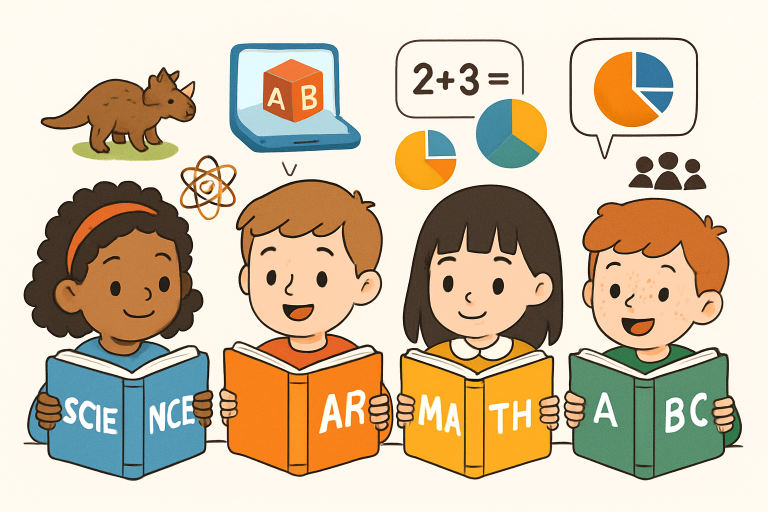
Enhanced interactivity and tailored experiences foster more effective learning outcomes. The collaborative impact of AR, AI, and digital publishing platforms ensures that illustrated books are no longer confined to print—they have become multidimensional, evolving, and profoundly engaging.
Notable Illustrated Educational Books
Several recent publications stand out for their innovation and impact. “Malala’s Magic Pencil” by Malala Yousafzai is a compelling testament to how illustration can amplify the themes of resilience and hope. The book’s rich visuals help young readers connect emotionally with Malala’s story, learning not only about global issues but also the importance of individual action.
“Love in the Library” by Maggie Tokuda-Hall is another exemplary title, depicting historical events through expressive, thought-provoking illustrations. By contextualizing complex subjects such as internment camps and wartime trauma, the book makes essential moments in history feel accessible and meaningful to children, helping them build empathy and context.
Innovative works like these are consistently recognized in publishing circles and recommended by major outlets, such as The New York Times Books section, for both their literary and educational merit. They set a high bar for the power of illustrated learning.
Impact of Illustrated Books on Learning Outcomes
Illustrated educational books have been shown to significantly improve both comprehension and engagement, as measured through various academic studies. A publication in Education Sciences documents that AI-generated, pedagogically aligned picture books lead to substantial gains in reading comprehension and increased enthusiasm for learning. Stories paired with relevant visuals cater to multiple learning styles, making them inclusive for children with different educational needs and backgrounds.
The combination of visual and textual information helps cement new vocabulary, reinforce major themes, and spark meaningful discussion. In practice, this means that students are more likely to remember and apply what they learn. Teachers routinely report that illustrated educational materials facilitate classroom participation and cooperative projects, resulting in lasting academic and social benefits.
Future Trends in Illustrated Educational Books
The seamless integration of advanced technology and dynamic storytelling defines the future of illustrated educational books. Cutting-edge systems, such as LEARN, a layout-to-image generation framework, aim to automate the creation of story-driven visuals tailored to pedagogical themes, particularly in STEM education. Such breakthroughs promise to support complex reasoning and spatial learning by presenting coherent sequences of highly relevant images.
Meanwhile, the use of data-driven feedback and collaborative creation between educators, illustrators, and technologists ensures a constant evolution of resources to meet emerging learning challenges. As hybrid and remote learning environments become standard, the demand for richly illustrated, interactive, and adaptive content is set to increase dramatically. Major educational publishers, such as Scholastic, are already investing heavily in this space, forecasting an exciting future for young learners everywhere.
Conclusion
Illustrated educational books remain a cornerstone of inspiring and practical learning. With the integration of AR, AI, and imaginative storytelling, these books offer new possibilities for engagement, understanding, and accessibility. As innovation accelerates across the publishing and educational sectors, the collective effort of writers, illustrators, teachers, and technologists will be essential in empowering the next generation to learn, grow, and dream without limits.